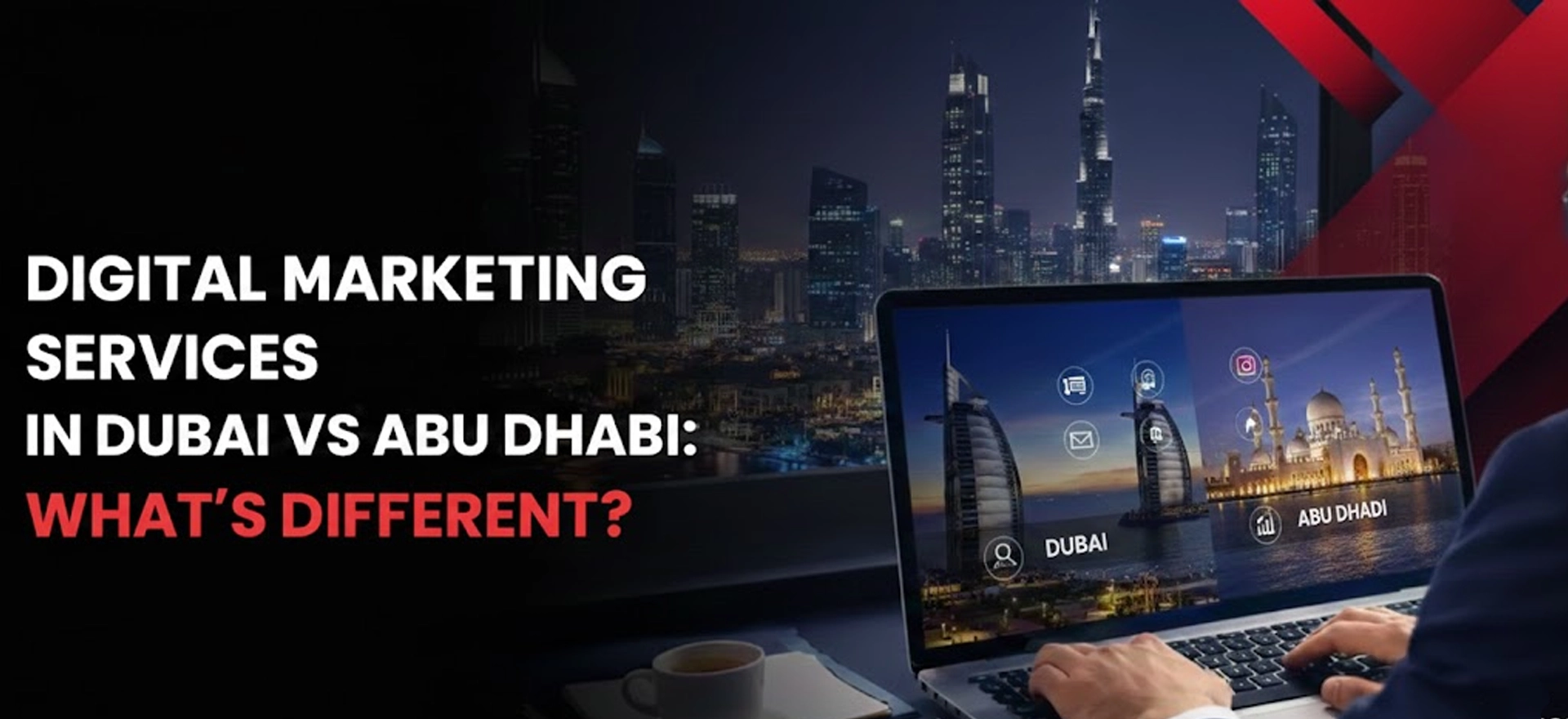
Digital marketing in the UAE needs location-specific strategies: Dubai favors aggressive and high-frequency B2C campaigns powered by social media influencers and tourism-focused content. In contrast, the economy of Abu Dhabi is B2B-heavy and government-led, focusing on professional LinkedIn networking, institutional trust-building and longer conversion cycles to meet complex regulatory requirements.
The UAE’s two largest emirates may share a country, but their digital marketing services landscapes all operate under completely different rules. If you’re running the same campaigns in Dubai and Abu Dhabi, you’re probably wasting budget on one side, or under-performing on the other.
After analyzing hundreds of campaigns in both cities, the differences go well beyond geographical proximity. From audience behavior patterns to regulatory frameworks, here’s what actually changes when you cross the emirate border.
Market Composition: Who You’re Actually Talking To
Dubai’s Fragmented Audience
Dubai’s population of 3.95 million with 92% expatriates represents over 200 nationalities according to Global Media Insight research. This results in a hyper-fragmented market where your digital marketing campaigns must speak multiple languages – literally and culturally.
The city economy is based on tourism that contributes 11.6% of GDP, retail, real estate and hospitality. This means consumer-focused businesses dominate the digital advertising space and competition for attention is brutal.
Abu Dhabi’s Concentrated Power
Abu Dhabi’s 4.14 million population is skewed towards government employees, oil sector professionals and B2B decision-makers. The non-oil sectors now account for 54.7% of Abu Dhabi’s economy with government and semi-government entities holding significant control, according to Statistics Centre Abu Dhabi.
This isn’t a consumer playground – it’s an institutional market in which purchase decisions involve committees, compliance layers and fiscal year budgets. Your digital marketing strategy has to reflect that reality.
| Feature | Dubai Strategy | Abu Dhabi Strategy |
| Primary Goal | B2C Volume & Brand Awareness | B2B Leads & Gov Contracts |
| Top Platforms | Instagram, TikTok, Snapchat | LinkedIn, Twitter (X), Direct PR |
| Avg. CPC (Google) | High (AED 8 – 25) | Moderate (AED 4 – 12) |
| Content Tone | Casual, Multilingual, Urgent | Formal, Arabic-First, Trust-Based |
| Sales Cycle | Short (Impulse) | Long (Fiscal Year/Tender) |
Platform Performance: Where Attention Actually Lives
Dubai: Instagram and TikTok Territory
TikTok has a 123.1% penetration in UAE with 11.3 million users aged 18+. Instagram continues to have a high engagement level as well according to DataReportal’s UAE Digital 2025 report. Visual platforms are leading the region due to the audience consuming content around lifestyle, dining, fashion, and experiences in Dubai.
Facebook still works for Dubai businesses, but primarily for community building and event promotion rather than direct response. The platform’s older demographic skew (35+) makes it less effective for Dubai’s youth-oriented retail and hospitality sectors.
Abu Dhabi: LinkedIn’s Hidden Goldmine
LinkedIn provides 4-6x better cost per qualified lead for Abu Dhabi B2B campaigns than Dubai, especially for government contractors, energy sector services and professional consulting. The decision-maker access of the platform is more important in Abu Dhabi’s institutional market for any digital agency in Dubai expanding into Abu Dhabi.
Twitter (X) still has surprising relevance in Abu Dhabi for real time government announcements, policy updates and official communications – so it’s critical for businesses serving government entities.
Budget Allocation: What Actually Works
Dubai’s Aggressive Spending Requirements
For competitive keywords in Dubai, the average CPC is AED 8-25 ($2.18-$6.81) across Google Ads, which is much higher than that of Abu Dhabi, where the range is AED 4-12 ($1.09-$3.27). This is a reflection of the saturated digital advertising market of Dubai where international brands and local businesses are fighting hard for a competitive edge.
Social media advertising in Dubai requires a minimum monthly budget of AED 10,000-15,000 ($2,723-$4,085) for meaningful reach, and influencer partnerships start from AED 5,000 ($1,361) for micro-influencers and scale up to AED 50,000+ ($13,612+) for established voices.
Abu Dhabi’s Efficiency Play
Abu Dhabi campaigns usually result in 30-40% lower acquisition costs despite lower audience pools. The less competition and more targeted B2B nature means that you’re not fighting retail brands for the same eyeballs.
However, deal sizes are larger and sales cycles are 2-3x longer than Dubai’s impulse driven market. Your digital strategy budget needs to support 6-12 month nurture campaigns and not immediate conversions.
Content Strategy: Speaking the Right Language
Dubai’s Multilingual Requirement
Effective Dubai campaigns have content in 3 or more languages: the English, Arabic, and Hindi/Urdu. The South Asian demographic accounts for 42% of Dubai’s population with massive purchasing power that most Western-focused campaigns completely miss.
Content themes that work in Dubai: Lifestyle Upgrades, Status Symbols, Limited Time Offers, Social Proof (Influencer Endorsements), Visual-First Messaging, ‘New/Exclusive/First In UAE’.
Abu Dhabi’s Formal Approach
Abu Dhabi content requires more formal Arabic – not the colloquial dialects that work in Dubai’s casual social environment. Government and institutional audiences have professional communication standards that reflect the conservative business culture of the emirate when dealing with any digital partner.
Winning content themes for Abu Dhabi: long-term value propositions, compliance credentials, partnership histories with government entities, case studies with institutional clients, thought leadership positioning, and sustainability/nationalization alignment.
SEO Dynamics: Local Search Behavior Differences
Dubai’s Competitive Keywords
Search terms such as ‘restaurants in Dubai,’ ‘best salon Dubai’ or ‘Dubai shopping’ have millions of searches per month with corresponding competition. Google’s local pack results favor businesses with 200+ reviews minimum for top positions, complete Google Business Profiles, and strong backlink profiles.
The transient nature of the population of Dubai means that local SEO needs constant review generation of 20-30 new reviews every month to keep them visible as customers leave the country.
Abu Dhabi’s Niche Opportunities
Abu Dhabi searches skew toward specific services: ‘government contractors Abu Dhabi,’ ‘B2B suppliers UAE,’ or ‘corporate services Abu Dhabi.’ Lower search volumes create less competition but higher intent for optimization strategies.
Local SEO in Abu Dhabi is aided by institutional backlinks – being featured in chamber of commerce directories, government supplier registries, or free zone authority websites holds a lot more weight than consumer review websites.
Regulatory Compliance: What You Can’t Do
Dubai’s Advertising Flexibility
Dubai is more creative in digital advertising, especially in the areas of lifestyle, fashion, and entertainment. The National Media Council guidelines are enforced but with interpretation room for modern marketing approaches.
Alcohol advertising remains restricted but restaurants and hotels can promote venues indirectly. Financial services advertising needs pre-approval from regulatory bodies but freedom in execution is available.
Abu Dhabi’s Stricter Standards
Abu Dhabi’s Department of Culture and Tourism has more conservative content standards, especially for imagery, cultural references and sensitivity to religion. Marketing materials aimed at government entities are subject to an extra level of scrutiny concerning government agencies campaigns.
Healthcare and financial services advertising is subject to much tighter pre-approval requirements in Abu Dhabi – with longer review timelines that must be factored into campaign launches.
Timing and Seasonality: When to Push Budget
Dubai’s Tourism-Driven Calendar
Dubai’s marketing peaks align with tourism seasons: October-April sees maximum competition and highest costs, while Dubai Shopping Festival in January triggers a 300% increase in retail advertising spend. Summer months (June-August) offer reduced competition but also reduced audience as residents travel.
Ramadan changes the digital landscape of Dubai with content shifting towards family values, charitable giving and evening-centric messaging as the number of daytime activities declines by 60%.
Abu Dhabi’s Fiscal Year Reality
Abu Dhabi’s government fiscal year (January-December) leads B2B marketing cycles. Q4 is characterized by rushed procurement as departments run out of budgets, whereas Q1 is characterized by planning phases with little purchasing.
Budget releases usually happen in March-April after the federal budget is approved, so that makes Q2 the ideal time to launch aggressive B2B campaigns targeting government entities.
Agency Partner Selection: Different Expertise Required
A Dubai-specialized agency knows consumer psychology, influencer networks, rapid campaign iteration and retail conversion optimization. These agencies are great at creative execution, social media management and quick response to market trends.
An Abu Dhabi focused partner brings government relationship experience, compliance expertise, B2B sales cycle management, and institutional credibility. These partners know the tender processes as well as procurement requirements and the patience required for committee-based decisions.
The best scenario: agencies with genuine operational presence in both emirates rather than Dubai agencies claiming Abu Dhabi expertise through occasional projects.
The Cost of Getting It Wrong
Running a Dubai playbook in Abu Dhabi is a waste of budget on consumer-focused platforms and an opportunity loss of LinkedIn possibilities and institutional networks. Your aggressive, flash sale creative gets ignored by decision makers looking for professional, value driven propositions.
Conversely, the application of Abu Dhabi’s formal, long-cycle approach in Dubai means that competitors will steal your customers while you are still in ‘nurture phase.’ Dubai’s market rewards boldness and penalizes indecision.
Conclusion
For businesses operating in both emirates, the answer isn’t to choose one strategy over the other – it’s to run parallel campaigns, optimized for the reality of each market. Your budget split should be based on revenue potential (not population ratios).
If selling consumer goods or services: 70% weight towards Dubai where purchasing frequency and average order values warrant higher acquisition costs. If targeting B2B or government contracts – Abu Dhabi deserves 60-70% allocation despite smaller audience because deal sizes make the economics work.
The emirates are becoming similar in some respects – Abu Dhabi is developing its tourism and entertainment industries and Dubai is attracting more institutional headquarters – but their fundamental market dynamics remain distinct. Your strategy must recognize that fact and not approach the UAE as a homogeneous market.
Successful UAE Marketing Isn’t A Choice Of Dubai or Abu Dhabi It’s about understanding that the 150km drive between them crosses into a completely different digital ecosystem requiring different strategies, budgets and expertise from your agency partner.
FAQs
What is the main difference between marketing in Dubai and Abu Dhabi?
The biggest difference is the target audience and sales cycle. Dubai is a fast-paced B2C market of tourism and retail dominated by visual social media (Instagram, TikTok) and influencer marketing driving fast sales. Abu Dhabi is a B2B and government-oriented market based on LinkedIn, formal communication, and developing long-term relationships for institutional contracts.
Is advertising cheaper in Dubai or Abu Dhabi?
Advertising is generally cheaper in Abu Dhabi. The average Cost-Per-Click (CPC) in Abu Dhabi is between AED 4 – 12, whereas the competitive market in Dubai pushes CPCs up to AED 8 – 25. However, while clicks are cheaper in Abu Dhabi, the sales cycle is longer (6-12 months) which means that you need a budget that can support long-term nurture campaigns.
Which social media platforms are best for UAE business?
It depends on the emirate. For Dubai, visual platforms such as Instagram, TikTok, and Snapchat are key to gaining access to the expat and tourist population. For Abu Dhabi, LinkedIn is the leading platform in terms of B2B and government lead generation and Twitter (X) continues to be important for official government news and policy-related engagement.
Do I need Arabic content for marketing in the UAE?
Yes, but the tone differs. In Dubai, marketing content is often effective in English, Hindi / Urdu, and informal Arabic. In Abu Dhabi, formal, professional Modern Standard Arabic is often a requirement, particularly when targeting government entities or local decision-makers who value cultural protocol.