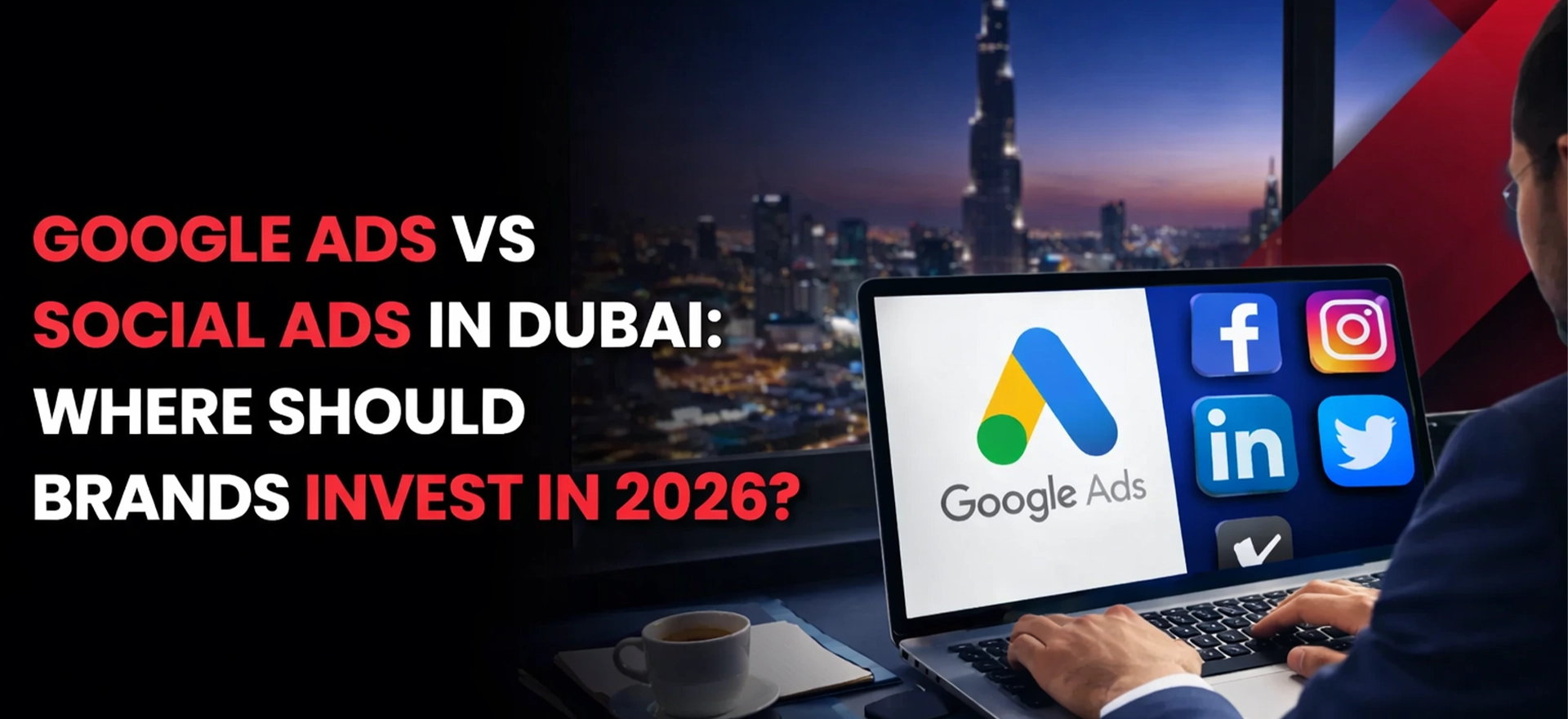
Dubai’s commercial landscape requires precision on every marketing dirham spent. With the UAE’s digital advertising market worth about $3.3 billion and projected to be expanding at 12% CAGR until 2030, brands are posed with the crucial question of where to spend their paid advertising budget for maximum returns in 2026.
For businesses looking for expert advice as they navigate this complex landscape, it is now crucial to take digital marketing services. The decision between Google Ads and social media advertising isn’t a matter of platform preference – it is a matter of knowing where your customers are actively searching, engaging and making purchasing decisions.
This comprehensive guide takes a Dubai-specific look at both channels to give decision-makers data-driven insights to optimise their advertising investments in 2026.
Dubai Digital Advertising Landscape:
The UAE has amazing digital connectivity which influences the advertising opportunities. According to DataReportal’s Digital 2026 report, the rate of internet penetration is 99%, with 11.3 million people online. The number of social media user users in the country has now reached 12.5 million-which is 110% of the total population, and is reflective of multiple account ownership across social media platforms.
Dubai residents spend around 3 hours on social media every day, and mobile internet speeds have a median speed of 614.42 Mbps – one of the fastest in the world. This provides a platform for both search-based and social-based advertising to flourish, but with very different strategic applications.
Social media advertising expenditure in UAE is expected to reach $663 million by 2029 with an 11% CAGR, while search advertising continues its steady growth trajectory. For brands operating in this dynamic market, knowing how each channel attracts the attention of the audience at various stages of the buyer journey is fundamental to success.
Understanding Google Ads in Dubai
What Google Ads is Best For
Google Ads is exceptional at acquiring high intent traffic, users who are actively looking for products, services or solutions. With Google ads operating around 90% of the global search engine market and more than 94% of UAE population using Google at least once a day, Google provides an unmatched access to decision-ready consumers.
In Dubai, Google Ads is especially powerful for service-based businesses where users have immediate needs. legal services, healthcare, real estate enquiries and business setup services. The platform captures demand when at its peak, when there is active interest in finding a solution.
Google Ads Cost Structure in Dubai
Dubai’s competitive commercial environment make ads costly. Based on 2025-2026 market data, average cost-per-click (CPC) varies greatly depending on industry and level of competition. Low competition keywords usually go from AED 3 to AED 10 per click, and competitive industries such as real estate, healthcare, education and business setup go from AED 10 to AED 30 per click. High-competition legal and financial keywords can go for more than AED 30 per click.
Based on industry benchmarks, most small to medium businesses in Dubai usually spend from AED 2,000 to AED 10,000 per month on Google Ads campaigns. Geographic targeting in premium locations such as Downtown Dubai or Dubai Marina can often provide higher bid rates than broader emirate-wide targeting.
Strengths of Google Ads
Google Ads gets you measurable and intent-driven results. The key strengths of the platform are high purchase intent with users actively seeking solutions, comprehensive tracking with every dirham accountable, immediate visibility when campaigns are launched and advanced targeting by location, language, device, and time. According to the WordStream’s 2025 Google Ads Benchmarks, the average conversion rate is 7.52%, and businesses usually earn about $2 for every $1 they spend – 200% ROI. Service sectors in the UAE tend to perform better than the global average click-through rates by about 20%.
Limitations of Google Ads
Despite its advantages, Google Ads comes with challenges for Dubai advertisers. Costs in competitive verticals can grow exponentially and some industries in the vertical sector can see a 20-30% increase in CPC year on year. The platform requires continuous optimization expertise to maintain efficiency, and it captures existing demand rather than creating new interest in products or services. Businesses with low brand awareness may find it difficult to compete with established businesses for high-value keywords.
Understanding Social Ads in Dubai
Why Social Advertising Works in Dubai
Dubai’s population has an exceptional social media engagement that has created a fertile ground for brand advertising. According to DataReportal Digital 2026, TikTok has more than 12 million users, Facebook has around 10 million users, Instagram has 8 million users, and LinkedIn has almost 10 million professional members.
The UAE’s young, tech-savvy population – with a median age of 31.6 – responds well to visual, video-first content. Short-form video on TikTok and Instagram Reels dominate consumption patterns with the multicultural population needing bilingual content strategies in English and Arabic to maximize reach.
Social Ads Cost Structure
Social media advertising costs in Dubai vary considerably by platform and objective. For Facebook and Instagram. For Facebook and Instagram, average CPC is AED 1.50 – AED 8.80 and CPM ranges from AED 10 – AED 50 depending on the targeting specificity. Cost per lead for good campaigns is an average of AED 25 to AED 55.
TikTok has competitive pricing combined with average CPC being around $1.00 and CPM being around $10 per 1000 impressions. LinkedIn commands premium rates for B2B targeting, with CPC ranging from AED 7 to AED 18 for general professional audiences and AED 15 to AED 30 for C-suite targeting.
Strengths of Social Ads
Social advertising is very good at building brands and engaging audiences. Key advantages include advanced demographic and interest-based targeting, capabilities in visualization via video and carousel formats, remarketing to website visitors and interested users and reduced entry costs to competitive search keywords. The platforms allow for brands to generate demand and awareness amongst audiences who may not necessarily be actively looking for solutions, and are therefore crucial for new product launches and brand building efforts.
Limitations of Social Ads
Social advertising has its inherent challenges in the Dubai market. Users are not actively seeking information about products, so harder, more creative hooks are required to get attention. Ad fatigue develops quickly without regular creative refreshes, and costs spike significantly during peak periods such as Ramadan, Dubai Shopping Festival, and year-end holidays.
Google Ads vs Social Ads: Side-by-Side Comparison
When comparing these channels in terms of the Dubai advertisers, a few key differences are apparent. In terms of user intent Google Ads is used for those who have high intent and are actively looking for solutions, whereas social ads are used for passive users who may be interrupted in the middle of browsing. For cost efficiency, Google usually provides higher CPC but improved conversion rates for intent driven purchase whereas social ads provide lower entry costs but might require more touchpoints to convert.
Regarding creative requirements, Google Ads is text-based messaging with some visual elements, whereas social ads require constant video and image content creation. For measurement clarity, Google provides direct attribution from search to conversion, whereas social requires more sophisticated multi-touch attribution models. Time to results is also different – Google Ads may deliver instant enquiries, whereas social advertising may need sustained campaigns to gain momentum.
Which Platform Works Best by Industry in Dubai
Different sectors benefit from platform specific strategies. For real estate, Google Ads is used to target high-intent buyers who are looking for specific properties while Instagram and TikTok are used to showcase property tours and lifestyle content. Hospitality and F&B brands feed on Instagram and TikTok’s visual storytelling, with Google capturing last-minute booking searches.
E-commerce businesses benefit from Google Shopping for product-specific searches alongside Facebook and Instagram remarketing for cart abandonment. B2B services consider LinkedIn critical to professional targeting and Google Ads to pick up service-specific searches. Healthcare and education industries use Google massively for information-seeking queries, with social proof runs on Facebook and Instagram.
Budget Allocation Strategies for Dubai Brands In 2026
Effective budget allocation is dependent on the maturity and goal of the business. For new brands looking to create awareness, a 70% social and 30% Google split allows audience building while capturing ready-to-buy searches. Established brands with recognition can shift to 50% Google and 50% social to balance demand capture with audience expansion.
Service based businesses with urgent customer needs often find 70% Google and 30% social beneficial as it prioritizes intent driven traffic. E-commerce brands are generally found to be successful with 40% Google (including Shopping) and 60% social (focusing on remarketing and dynamic product ads).
Monthly budget recommendations for Dubai SMEs are AED 3000 to AED 15,000 for single platform testing and AED 15,000 to AED 50,000 for integrated multi-platform strategies. Seasonal adjustments are critical – brands must ensure they increase budgets by 25-50% during Ramadan, Dubai shopping festival and major retail periods.
Why the Best-Performing Dubai Brands Use Both Channels
Top-performing Dubai brands are well aware that Google Ads and social advertising play complementary roles in the customer journey. A reliable digital agency in Dubai, understands that social media creates initial awareness and consideration, building brand familiarity through repeated exposure to engaging content.
When these same audiences go on to search for relevant products or services, brand recognition increases click-through rates on Google Ads. The combination has a flywheel effect: Social generates demand, search captures intent, remarketing feeds back into both these channels. This integrated approach usually offers 20-30% better overall performance than single channel strategies.
Common Mistakes Dubai Brands Make with Paid Advertising
Several repeated errors debilitate the efficiency of advertisement in the Dubai market. Many brands go without proper conversion tracking and, as a result, are unable to measure their ROI. Others forget about bilingual targeting when it comes to reaching the Arabic-speaking audience or localizing creative for cultural relevance.
Budget fragmentation across too many platforms, dilutes impact, while ignoring negative keywords in Google campaigns wastes spend in irrelevant traffic. Creative fatigue from the same ads running for long periods of time weakens engagement, and poor landing page experiences kills conversion potential no matter how good the ad was. Seasonal timing mistakes like launching major campaigns at low activity periods, or missing peak seasons, wastes opportunities for maximum impact.
How a Digital Marketing Agency in Dubai Helps Brands Decide
A reliable digital marketing agency in Dubai like Right Media adds vital knowledge to the platform choice and allocation of budgets. Agencies do in-depth market analysis to determine where competitors excel and where there are opportunities for gaps. They do in-depth tracking systems to gauge the true cross channels attribution and create creative strategies based on local audience preferences and cultural nuances.
Perhaps most importantly, experienced agencies optimize continuously based on performance data whereby budgets are shifted between platforms and campaigns in order to generate maximum returns. Their familiarity with Dubai’s unique market dynamics, including seasonality, culture, and competition, speeds up results and shortens any expensive trial and error phases.
Conclusion: Where Dubai Brands Should Invest in 2026
The Google Ads versus social ads decision is not binary for Dubai brands in 2026. With 99% internet penetration and 110% social media reach, and a sophisticated digital consumer base, the UAE market rewards integrated strategies that leverage each platform’s strengths.
The most successful way to go about 2026 is to use both channels strategically, making budget decisions based on business goals, industry and seasonality. Working with an experienced digital marketing Dubai partner means that each advertising Dirham is being put to efficient use that will lead to quantifiable business outcomes.
In the competitive marketplace of Dubai, the question is not which platform to choose – it’s how to orchestrate both channels into an integrated strategy that will gain attention, build consideration, and drive conversions throughout the entire customer journey.