Your website isn’t your digital brochure anymore. In 2026, it’s your hardest working salesperson, your 24/7 customer service representative, and your most visible brand ambassador. But here is the catch, all of that doesn’t matter if people can’t find you online.
That’s where the magic comes in to play when web design meets SEO. These two disciplines have become so interlinked that to be able to treat them separately is to build a car with a beautiful exterior but forget to install the engine. Modern search engines don’t just look at your content – they assess how your entire website performs, loads and feels to people.
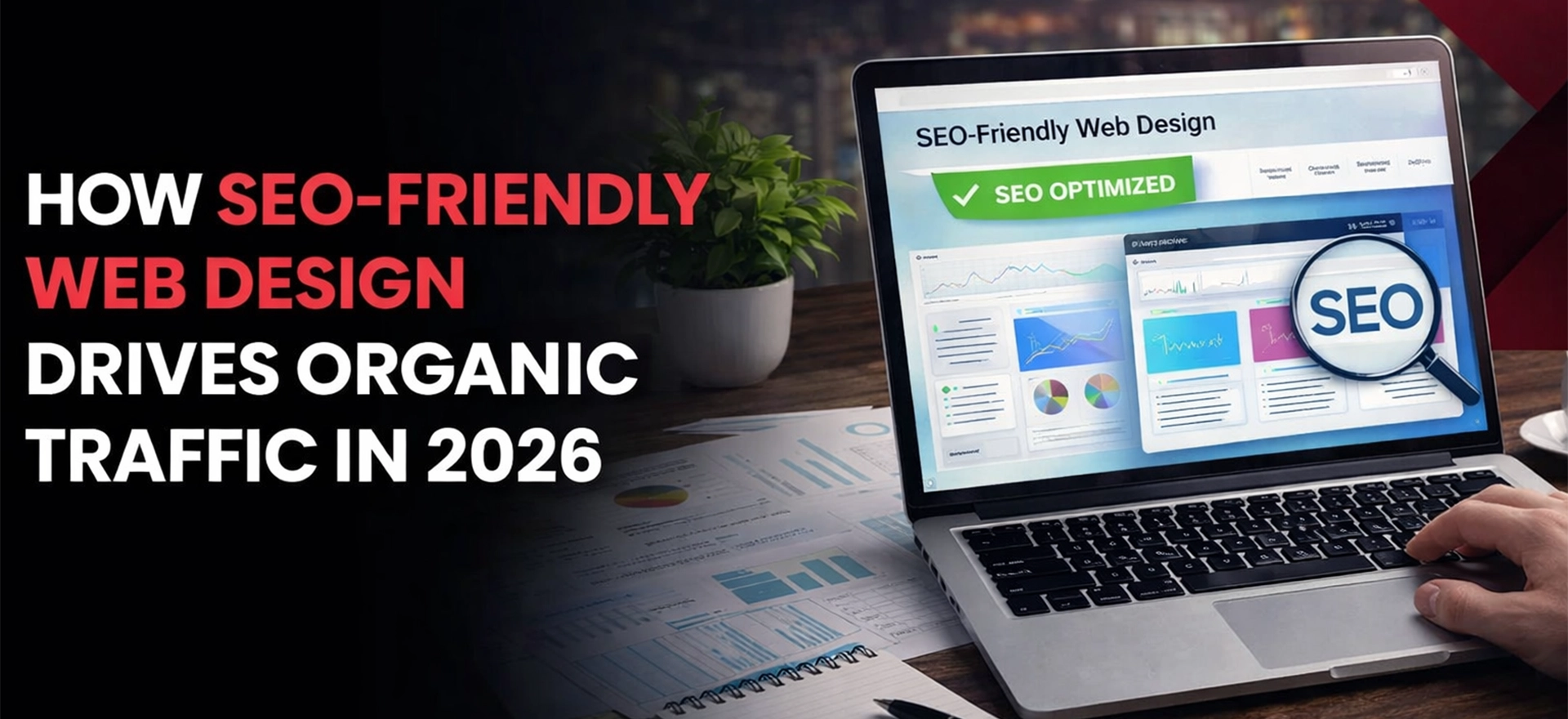
The good news? When you get this combination right, organic search can be your most powerful source of traffic. According to BrightEdge research, organic search, by far, drives more than half of all trackable website traffic – far outpacing social media, paid ads and every other channel combined. Let’s take a look at how SEO-Friendly web design drives organic traffic in 2026 and how you capture your traffic share.
Why Every Design Decision Is Now an SEO Decision
Google’s algorithm has changed drastically over the years. The search giant no longer merely crawls your text searching for keywords – they now assess the full user experience that your website provides. Page speed, mobile friendliness, visual stability and intuitive navigation are all factors that feed directly into how Google ranks your pages.
Think about it from the perspective of Google. Their whole business model is predicated on providing results that are satisfying to users. If someone clicks on a search result and ends up on a slow, clunky, confusing website, he or she will bounce back to Google frustrated. That’s a bad experience Google wants to avoid and that’s why they are now rewarding websites that prioritize the user experience with better rankings.
This shift means that every design choice you make – from your color scheme to your navigation structure to your image file sizes – has SEO implications. The Conductor State of SEO Survey has found that 91% of marketers say SEO has positive effects on their website performance and business goals. The businesses that are going to be winning at SEO in 2026 are those that are treating their web designers and SEO specialists as partners rather than different teams.
Key Web Design Elements That Influence SEO
Below are major key web design elements that influence SEO:
1. Mobile-First Design: The Non-Negotiable Foundation
Here’s a reality check: most of your visitors are likely to be reading this on their phones. Mobile devices now constitute almost two-thirds of entire global web traffic according to the latest statistics by Statista, and in response to this Google has made mobile-first indexing a standard for all websites.
What does mobile-first indexing mean for you? Simply put, Google will predominantly use the mobile version of your website to determine what your rankings are – even for desktop searches. If your mobile experience is clunky, slow or difficult to navigate, then your rankings will suffer no matter how good your desktop site looks.
A good web design agency in Dubai knows that mobile first design is not about taking your desktop website and shrinking it to fit on smaller screens. It’s about designing for mobile devices first, and scaling up to bigger screens. This way, navigation will stay thumb-friendly, content can be read without having to zoom and load times can be kept fast, even on cellular connections.
Practical mobile-first design, i.e., larger tap targets, simplified navigation menus, intelligent image compression and no intrusive pop-ups. These aren’t nice-to-haves – they are ranking factors.
2. Site Performance and Core Web Vitals
We’ve all been there when we were trying to work with a website and it was taking forever to load. Maybe you’ve watched a progress bar crawl along, or worse, watched content shift around just as you were about to click something. Google has measured these frustrations into three specific metrics called Core Web Vitals, and these are now official ranking factors.
According to Google’s official documentation, here’s what you should be aiming for: your main content should be loading within 2.5 seconds (Largest Contentful Paint), your page should be responding to user interactions within 200 milliseconds (Interaction to Next Paint), and visual elements shouldn’t be shifting around unexpectedly (Cumulative Layout Shift should be below 0.1).
The business impact of the speed is staggering. Research from Google shows that the bounce probability is increased by 32% when page load time increases from one second to three seconds. That is not a typo – a two-second delay can cost you nearly a third of your potential visitors. When Vodafone were able to improve their load times by 31%, they experienced an 8% increase in sales. When Rakuten optimized their Core Web Vitals, conversions increased by 33%.
Want to see where your website speed stands? Run it through Google PageSpeed Insights – it’s free, and it will give you specific recommendations for improvement. Common fixes include image compression, reducing JavaScript, using browser caching and the use of a content delivery network (CDN).
3. Responsiveness:
Your visitors may be on a smartphone on their morning commute, continue surfing on a laptop at work, and make a purchase from a tablet on their couch. Responsive design makes them receive a seamless experience regardless of the device without keeping multiple versions of your website.
From an SEO standpoint, responsive design brings up a number of advantages. Google makes an explicit recommendation of it because of the fact that it makes things easier for crawling and indexing – there’s only one web address for search engines to find and rank. It also takes care of the duplicate content problems that can occur when you have separate mobile and desktop sites. Plus, responsive frameworks tend to result in cleaner, more efficient code that search engines can parse with greater ease.
Professional web design services in Dubai now take responsive frameworks for granted as the baseline norm as they understand that the users of today expect to seamlessly transition from one device to the next.
4. Smart Site Architecture:
Imagine you are walking into a huge library and the books are lying randomly on the floor rather than on shelves. You’d probably give up and go away. That’s in fact exactly what happens when people land on a poorly structured website – and so do search engines.
Good site architecture serves two masters: human visitors that need to find information quickly and search engine crawlers that need to understand how your content relates. The best websites have both: logical hierarchies, navigation and strategic internal linking.
Key principles include: keeping important pages within three clicks of your homepage, using descriptive URLs that include relevant keywords, creating internal links that help users discover related content, and using XML sitemaps. Schema markup can also get you a better search appearance such as star ratings and FAQs.
User experience metrics are now more important than ever. When visitors can’t find what they need, they leave – and that high bounce rate tells Google your site isn’t doing a good job of delivering value. Intuitive navigation isn’t good design, it’s good SEO.
Real Results: What Happens When Design Meets SEO
Theory is good, but results are important. Let’s see what happens when businesses actually invest in web design that is SEO friendly. Platt College redesigned their website keeping SEO principles in mind and witnessed organic traffic increase by 48% according to Blacksmith Agency’s case study. Potters Carpets & Beds experienced 79% organic traffic growth over 12 months after optimization, with their keyword rankings more than doubling from 443 to 910 keywords, as documented by Loop Digital.
Perhaps most impressive, a software company detailed in SeoProfy’s case study went from 20,000 to 200,000 monthly visitors after full optimization – a tenfold increase that equaled an estimated $18,400 in traffic value per month. These aren’t anomalies, these are examples of what’s possible when design and SEO work together.
Your Action Plan: Where to Start
Feeling overwhelmed? Don’t be. Start with these high-impact priorities:
- First thing you need to do is audit your current performance: Run your site through PageSpeed Insights and Google Search Console to get an idea of where you are in terms of Core Web Vitals and what exactly the issues are.
- Second, put the mobile experience first: Test your site across a number of devices. Is it easy for navigation just using a thumb? Does content load fast on cellular connections? Are buttons large enough to be able to tap accurately?
- Third, tackle speed issues: Compress images, enable caching, reduce code bloat. Even small improvements add up to significant ranking improvements.
- Fourth, review your site structure: Can users find important pages within three clicks? Does your internal linking guide visitors to related content? Is your navigation intuitive?
For ongoing monitoring, configure Google Analytics to track user behavior and use tools such as GTmetrix for in-depth performance analysis. Working with talented and experienced web design Dubai professionals can help you to progress quickly, as well as help ensure that you’re implementing best practices from the very beginning.
Conclusion:
In 2026, SEO-friendly web design is not a luxury or an afterthought – it’s a competitive necessity. The websites winning organic traffic are those that are fast loading, beautiful on mobile, intuitive in their guidance and providing real value at every touchpoint.
The difference between those websites that meet these standards and those that do not is real competitive advantage. Every day your site underperforms is a day you’re losing potential customers to competitors who’ve invested in getting this right.
Ready to turn your website into a traffic engine with organic traffic? Start with an audit, focus on quick wins and consider working with Right Media that knows both web design excellence and SEO strategy. Your future customers are looking for you right now – don’t let them miss!
Author Bio
Kashaf Khan is an SEO specialist with deep expertise in AI SEO and generative engine optimization. Armed with a Master’s in Computer Science, he leverages his algorithmic knowledge to help brands dominate both traditional and AI-powered search landscapes.